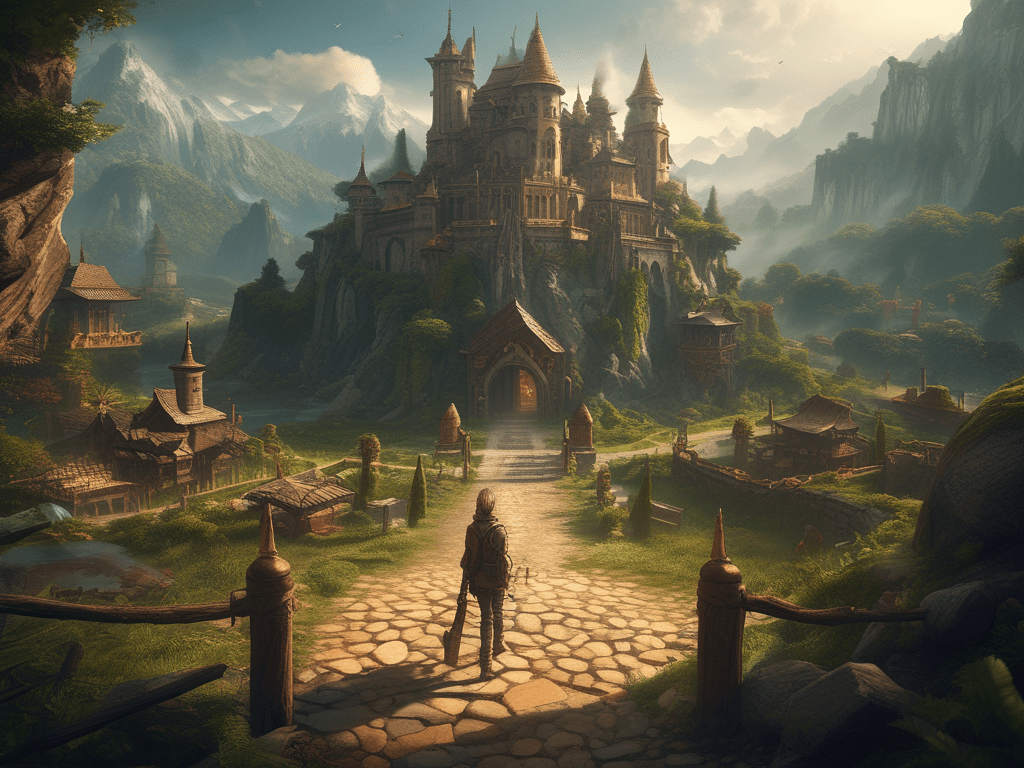
Hola and welcome to world building! As previously stated in the preceding posts, I will be approaching this topic from the perspective of a fantasy writer, but the main elements should still be applicable to other genres. That said, let us begin!
World building can be tricky, especially if you’re new to it. After all, how do you create an entire world? Well the first step is to let your imagination run wild, because it’s never going to happen otherwise. Being serious, however, you need to pick a starting point, and I would start simple. Where does your character(s) live? What kind of person are they? Now, how do the place/places they grew up in shape them into that? A sheltered, naive princess likely grew up confined to a splendorous castle or palace, maybe even to only a portion of it, locked away from the harsh realities of life. A battle-hardened, world-weary orphan may have grown up on the streets of a dog-eat-dog town where might makes right. Conversely, they may have had a fairly decent living station and rejected it due to the attitudes the people around them had.
Figure out where your character lives first, because that will be integral to who your character is, even if only a portion (or even none) of the story is spent there.
Then, determine the terrain. What sort of land does the story take place in? Are there lush forests? Ports by the ocean? Majestic mountains? Grassy plains? Barren wastelands? Perhaps there’s a mix, and your character is traveling through them all. Based off of the terrain, ask how it would shape the culture of your world. A sea port may have a lot of mixed races and languages, colorful wares being sold from all across the world. A village in the mountains may rely on income from mining precious stone and eat things from homegrown gardens or livestock rather than a lot of food bought from outside. A town in a desert will probably have the residents wearing flowing clothes and head coverings to protect them from the sun’s heat and the sand.
Now ask what kind of people and animals live there. What fantastical (or non-fantastical) creatures would live in this climate? Are there mythical races here, mingled with humans? Or perhaps there are no humans at all, and this is a world of elves, dwarfs, or fairies. Maybe you’ll even make up some fantasy races or creatures yourself! Choose wisely here. Much like in real places where you won’t find a polar bear in the middle of the Amazon rainforest or whale in the desert, there are different places and races that are most suited for different climates. If you shake things up, make sure there is a reason for it. No ice dragon is going to feel comfortable living on an active volcanic island, and no sun elf is going to thrive in a perpetually cloudy or stormy environment.
Great, now you should have your basic building blocks: the foundation of your fantastical world. You have the place of origin for your character, you have the essential type of world they live in, you have the people and creatures they’re surrounded with. So now we can get into details.
What is the government like in this world? Is this a kingdom, an empire, a democracy? Is it a no-man’s land deal, or is there a royal family presiding over the land? Perhaps a council of people that make the important decisions? Is there a system of hierarchy? Allow me to give you the answer to the last question. Yes, there should be a system of hierarchy. Before anyone gets upset with me, maybe you wanted to make a land where everyone is on equal standing, let me explain. While this is fiction, the world needs to feel believable. You can make up some of the most bizarre creatures in the universe for your world, but your job is to make the reader believe that, in this world, in this story, they are one hundred percent a reality. Realistically, people always have a hierarchy of some sort. If there’s a race in your universe that miraculously doesn’t, it’s a utopia, and it will feel surreal. You may use this, especially if there’s a point to it, but I’d strongly advise not letting it be the main world your character lives in, because the whole thing will feel something like a dream, or even straight up fake. As unfortunate as it is, at the end of the day, people will always want to feel like they’re better than someone else. So even if you try to take away hierarchy, the characters in the story will likely just subtly create their own, and claim they don’t have one.
Now I know politics can be annoying, and not everyone wants to think about them. I don’t! I don’t enjoy politics at all, personally. That does not change the fact that they are important and often shape a lot of the world we live in. So even if you don’t enjoy it a lot, even if it’s not going to be particularly important to your story, I strongly recommend getting at least a vague grasp of what the governmental situation of your world is, because it does affect day-to-day life, even if we don’t notice it.
This next step is a bit more optional. Likely only those of you who are going to be writing adventure stories or have a character who knows everything about geography will need it. Make a map. Give yourself an idea of where everything is. Draw one yourself on paper if you’re up to the challenge, or describe the terrain and locations of the important places to someone else who is. You could even search up map makers online if you wanted to. It will help you keep track of where everything is, what the distances are, which way your characters are going. Most importantly, if you have a good idea of your character’s location in reference to their world, so will your readers, and they won’t get lost or confused.
Now I doubt you’re all history buffs. Not everyone is! And not everyone will need a backstory for their entire world to be able to write their story. However, it is often very useful. Much like the world you create affects the person your main character is, the history of that world affects how it is now. You may not need much of it at all, but some of you may be writing books that will heavily rely on past events. So don’t be afraid to create a history for your world. What parts of it are important to your story? Focus on that primarily, then expand if you wish. Maybe you have a town full of people who practice magic, and their origins are crucial to the book’s events. How did they get their magic? Is it learned from scratch? Is it hereditary? Did someone give it to them generations ago? Or did their ancestors find some magical source? Maybe you have a kingdom on the brink of war. How did that war start? What was the point? How long has it been brewing for? How does it tie into the story? Perhaps your story centers around a prophecy from centuries ago. Who gave the prophecy and why? How real is it? It’s possible that your world is merely one of many. How did the inhabitants get to this universe? Did it always exist? Is it connected to another world in some way?
If there’s one thing I can stress most when it comes to world building, it would be ask questions. Ask yourself questions about everything (but first the important things!), then find the answers. Don’t be afraid to get curious about how this world works, and definitely do not be afraid of over-developing the world. Even if you have mountains of information that will never make it into your book, my belief is the more developed a world is, the more real it feels. The grasp you have on your fictional world will define how well you can write about it.
There is nothing wrong with merely doing what it is you need to do, and leaving it there, but don’t do so merely because you’re afraid to go any deeper.
When you create a world, you’re exploring that world. You’re the first person ever to learn about its culture, its history, its language and mannerisms. There is no wrong way to start and no limit to how far you can go.
Please share your own experiences with world building in the comments! What are things you’ve found useful? What parts of world building do you enjoy the most, or conversely, struggle with the most?
Side tip: When creating the culture of a world or land, take inspiration from real life cultures! You don’t have to copy and paste, but it can help you get a grasp of what people living in different parts of the world who deal with different terrain and animals are likely to have in common (often for a reason!)
 Abigail Fredrickson
Leave a comment